
Brian Moore is Wrong
The Rich exist, and have conned impressionable young libertarians into kissing their own chains

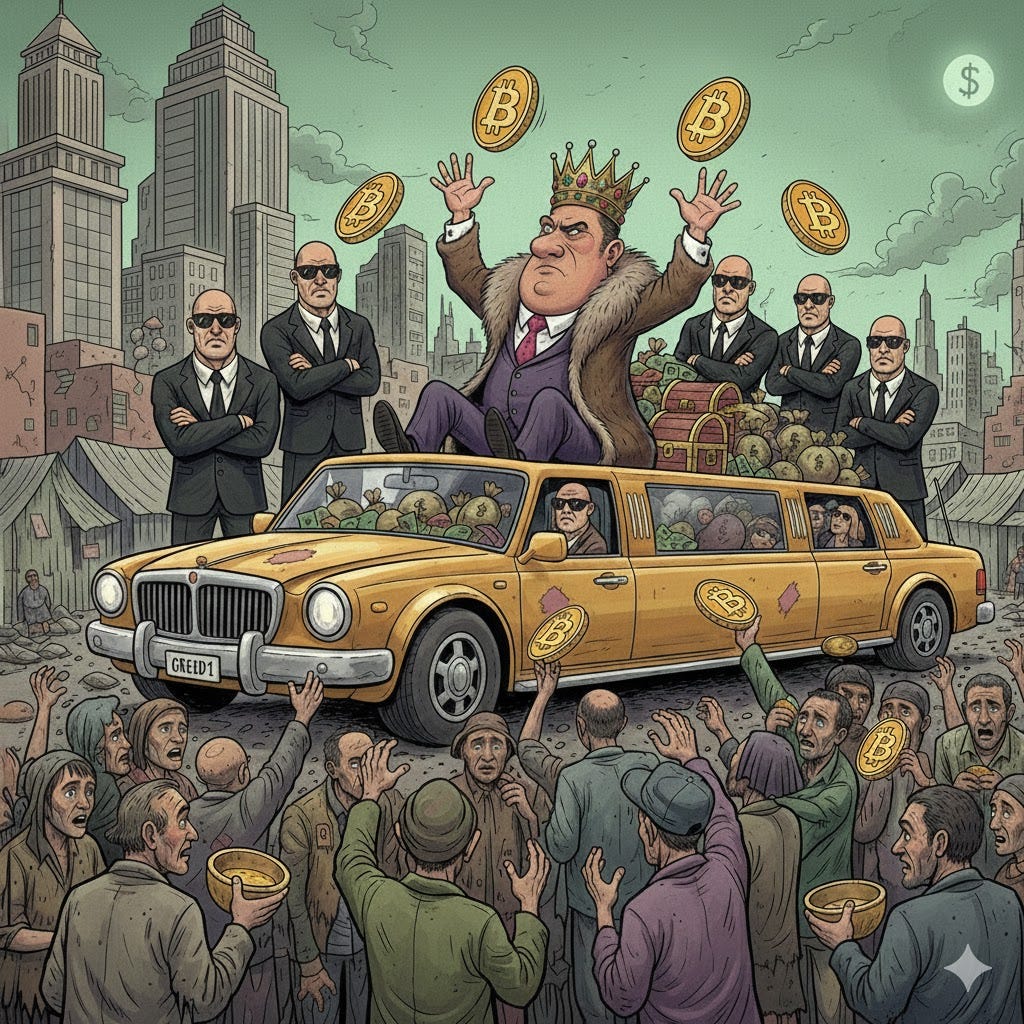
This is an invited challenge to Brian Moore’s article defending The Rich. At least the ones he defines as good-rich:

It grew out of a side exchange1 we had over the canard that “you can’t tax unrealized capital gains”. TL;DR: average Americans are already taxed annually on the unrealized gains on their main asset, their homes.
I thought the debate had been a pretty good one, all things considered. Mercifully free/light on ad hominem and fairly succinctly captured the two sides. It looped a little, but I thought it would be worthy of a full-blown point-counterpoint. I offered him the first shot in the duel and he pointed me at his previous article, above.
So my turn.
1)
Brian’s main thesis seems to be about the moral valences/judgments applied to the Super Haves. That some are good (what he calls the “producers”) and some are bad (the “consumers“). Warren Buffett as archetype of the former, given his famously frugal lifestyle, even as the 10th richest person in the world.
This seems like a bizarre starting point for someone who’s entire idea system is based on Liberty. What difference does it make how someone disposes of their wealth?? The economy is powered by consumption. It needs savings. It needs investment. All three. Those of us like Mitt Romney and Buffett himself who are pushing the idea and slogan of Tax the Rich (not Eat or Kill, just tax) aren’t making moral judgments.
It’s about interests, power and pragmatics. There’s no compelling data supporting the idea that ever stretched skew of the distribution curve is necessary for overall growth of the economy and shared progress and prosperity. Let alone that the Super Haves are somehow more moral, so a fiscal system where the share of taxes is a little more proportional to utility (yes, I know that’s not cardinal … it’s fine as a fuzzy concept for my purposes here) isn’t “punishing” them for their successful good behavior.
2)
Brian starts off with a historical howler, arguing that in antiquity, being rich was only about consumption. I guess he’s never heard about Julius Caesar’s will, gifting three months wages’ equivalent to all 320,000 male citizens of Rome … in coin.
That wealth of JC’s was lying around, literally “hoard[ed] currency in a box somewhere”.
Nobles have always needed cash, for large purchases, paying armies and taxes, making loans to earn interest, … Keeping some on hand has always been a best practice, even if it comes from looting someone else’s hoard or taxing their commoners.
Throughout history, the balance sheets of The Rich have included various asset classes: land producing income; profits from trade; tenants, slaves producing goods and services for sale; liquid coinage, bullion, precious stones and other luxuries like silk; … The Romans even had the concept of shares/partes, though it was never fleshed out into public markets, and was abandoned and dormant for a millennium during the Dark Ages until revived in the late Medieval period, contributing to the banking revolution that launched the Renaissance, among other civilizational benefits.
See Niall Ferguson’s The Ascent of Money: A Financial History of the World (2008).
3)
In the wind-up for his grand conclusion (see below), Brian includes another howler which I will quote in full:
Everyone today agrees that Warren Buffett is rich, but prehistoric cavemen, ancient Greeks and early Christians, who assembled a mass of cultural, social and religious norms around “wealth,” would not. They would see a man whose home, clothes and food reflect the lifestyle of a non-rich, non-elite person3. This is not a man who would hold lavish feasts, live in the largest marble home or field vast armies of servants. He doesn’t even seem to hold a rank in the Senate! The only thing he seems to have in abundance are these worthless slips of green papyrus.
Buffett’s wealth is not in green papyrus. It’s in bits in a vast array of digital ledgers, all secured ultimately by the power of the US Department of Defense which backs up the power of the US-dominated global financial system, resting on the USD as (still) the primary reserve currency for the entire planet.
Buffett could trivially fly in on a private airplane (rented NetJets is his preference these days) that would dazzle those ancients to the point of thinking he’s a deity from the sky. They wouldn’t just have thought him wealthy, they would have thought him divine.
A caveman wouldn’t understand a textile like silk, which would appear to him as magical as Tolkien’s mithril mail. Greeks and early Christians would certainly recognize a wealthy man who lived modestly and called shots right around the economy, political system and society. Famous Roman Stoics like Seneca the Younger and the Emperor Marcus Aurelius lived simply, specifically not to become slaves to their riches.
4)
For his conclusion:
But more importantly than proper nomenclature, we also need to refactor society, particularly our tax code, to treat the two categories differently. Every tax on a thing disincentivizes that thing. Therefore, our current tax system, heavily skewed to income tax, reduces the incentives for those good-rich, the hopeful producers, to do their thing, which is “making stuff for everyone.” We should therefore shift, as much as possible, to a system that taxes consumption6, so as to proportionately disincentivize consumption - which, again, is “reducing the amount of stuff that everyone has.” Our tax system should follow our moral intuitions.
“Tax = disincentive” is one of the tropes that laissez-faire zealots love to drag out. First and most obviously, that depends on many factors, especially price elasticity of demand and substitution effects (e.g. take more vacation time in lieu of a big cash bonus). Second, of the three categories of tax almost all of us pay, on (1) income, (2) consumption (= sales tax), and (3) wealth (= (a) real estate assessment based annual taxes, and (b) capital gains), which activity would we pick to disincentivize?
If you said “none of the above”, which is why the tax code tries to maintain them in equilibrium, give yourself a cookie.
The two most important KPIs of the economy — which most libtarians seldom talk about — are Productivity and Personal Consumption. Does anyone really think modest income tax rises reduce the level of effort and productivity at work? That non-Super Haves will slack off and so double the pain to their bottom lines by reducing the top lines of their Income Statements while the tax cost line is increasing simultaneously beyond their control? That Elon Musk as the archetype Richie Rich will work less hard and be less innovative and productive if his compensation goes down from a $Trillion to a $Billion???
By the same token, that demand for home ownership is reduced in High Tax states like Texas because Houston’s 2.5% bite is greater than San Jose, CA’s 1.5%???
Brian’s idea that we should focus taxation on consumption is even nuttier when personal consumption represents 70% of GDP. Talk about something we want to incentivize, not the opposite. Deflation is worse than inflation, as the world learned in the 1930s, and, thankfully implemented emergency measures to prevent both in 2008 and 2020.
“Our tax system should follow our moral intuitions” is not a good idea in a society as large, complex and diverse as ours. There are no shared moral intuitions. The Rich and the non-Rich exist in natural political adversarial opposition, their interests as diametrically opposed as the zero-sum closing price of transactions between any buyer and seller … between farmers and eaters, borrowers and creditors, oil drillers and car drivers, etc... They may have a shared interest in a vibrant market … high Velocity … where both sides are incented to transact, but not on prices.
Government is about pragmatics, not ethics. Balancing all these adversarial interests.
Designing tax codes is not something for amateurs, even the brilliant authors on Substack .. even even those with lofty goals to “refactor society”.
Gotta give Brian credit for his ambition. As I told him at the end of our Comments thread, he’s got my vote in 2028 … assuming Mitt Romney’s not on the ballot.
In California, our EC votes are already counted, so symbolism is all I’ve got.
Read the full exchange upward from Brian’s final word here: